
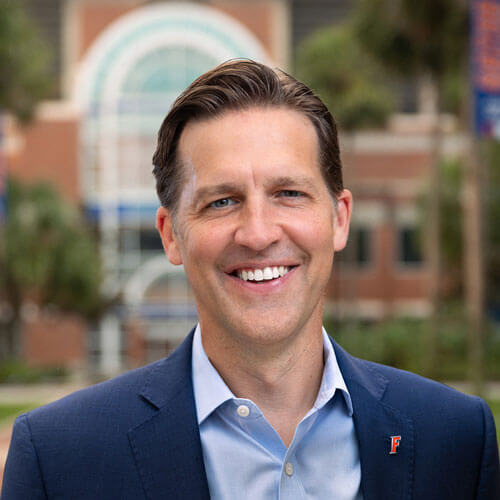
AbOUT BEN SASSE
Benjamin Eric Sasse, born February 22, 1972, in Plainview, Nebraska, is an American politician, academic administrator, and author whose career has spanned government service, higher education leadership, and a decade in the United States Senate. A Republican known for his willingness to break with party orthodoxy, Sasse built a reputation as one of Washington’s most intellectually serious and independent-minded voices during an era of intense polarization.
Educated at Harvard, St. John’s College, and Yale, where he earned a PhD in history, Sasse brought an academic rigor to public life that was uncommon among his Senate colleagues. Before his political career, he served in the U.S. Departments of Justice, Homeland Security, and Health and Human Services under President George W. Bush, and later led Midland University in Nebraska through a dramatic institutional turnaround. Elected to the Senate in 2014 and re-elected in 2020, Sasse served until January 2023, when he resigned to become president of the University of Florida. He resigned from that role in July 2024 due to his wife’s declining health. In December 2025, he publicly announced a terminal diagnosis of stage-four pancreatic cancer.
Throughout his career, Sasse was a consistent critic of Donald Trump and one of only seven Republican senators to vote to convict Trump in his second impeachment trial. At the same time, he remained a committed conservative on issues ranging from health care to foreign policy. Colleagues on both sides of the aisle have described him as a rare example of a senator who thought beyond the next news cycle.
Early Career
Following his graduation from Harvard in 1994, Sasse entered the private sector, spending roughly a year as an associate consultant at the Boston Consulting Group. He then transitioned to the nonprofit world, serving as a consultant and executive director for Christians United For Reformation, known as CURE. When CURE merged with the Alliance of Confessing Evangelicals, known as ACE, Sasse became executive director of ACE in Anaheim, California, a role that reflected both his theological convictions and his organizational abilities.
In January 2004, Sasse joined the U.S. Department of Justice as chief of staff for the Office of Legal Policy, while also serving as a part-time assistant professor at the University of Texas at Austin. He left the DOJ in 2005 to serve briefly as chief of staff to Representative Jeff Fortenberry, then advised the U.S. Department of Homeland Security on national security matters. By September 2005, he had returned to the University of Texas in a full-time teaching capacity.
From December 2006 onward, Sasse moved into a senior advisory role at the U.S. Department of Health and Human Services, serving as counselor to the Secretary on a wide range of health policy issues, including healthcare access and food safety. In July 2007, President George W. Bush nominated him as Assistant Secretary of Health and Human Services for Planning and Evaluation. The Senate confirmed him in December 2007, and he served in the role through the end of the Bush administration in January 2009, taking unpaid leave from the University of Texas to do so.
After leaving government in 2009, Sasse returned to academic and advisory work, consulting for private equity clients and health care investors while teaching at the University of Texas. He joined the Lyndon B. Johnson School of Public Affairs Center for Politics and Governance as a fellow in October 2009, before his appointment at Midland University later that year.
Midland Lutheran College
In October 2009, Sasse was announced as the 15th president of Midland Lutheran College in Fremont, Nebraska. The institution had a personal connection for him, as his grandfather Elmer Sasse had once served as the college’s vice president of finance. At 37, Sasse was among the youngest chief executives in American higher education. He assumed leadership of the 128-year-old school in the spring of 2010, taking office officially on December 10, 2010.
The institution he inherited was in serious difficulty. Enrollment had fallen to a historic low of 590 students, and the college was, in the words of observers, “on the verge of bankruptcy.” Sasse moved quickly to stabilize and revitalize the school. He oversaw a comprehensive rebranding, renaming the institution Midland University, and implemented a range of academic reforms, including mandatory class attendance and unannounced quizzes. He also proved to be a prodigious fundraiser.
The results were substantial. During his tenure, enrollment more than doubled, growing from 590 to approximately 1,300 students. When nearby Dana College was forced to close, Sasse moved to hire much of its faculty and facilitate the transfer of most of its students to Midland. This strengthened the institution while serving displaced students and faculty alike. Observers credited Sasse with genuinely turning the college around.
When Sasse announced his intention to run for the U.S. Senate, the board of Midland asked him to remain in place under a partial leave of absence rather than resign outright. Following his primary victory, he announced he would step down as president effective December 31, 2014, closing a chapter widely regarded as one of the institution’s most consequential periods of leadership.
US Senate
In October 2013, Sasse announced his candidacy for the Nebraska Senate seat being vacated by the retiring Mike Johanns. Running on a firmly conservative platform centered on opposition to the Affordable Care Act, he called himself “the anti-Obamacare candidate.” Sasse distinguished himself quickly as a formidable fundraiser, breaking Nebraska’s previous quarterly record for individual donor contributions with nearly $815,000 raised in his first quarter.
He won the May 2014 Republican primary decisively, carrying 92 of 93 counties and capturing nearly 50 percent of the vote. In the November general election, he defeated Democratic nominee David Domina with 64.4 percent of the vote. He was sworn into the Senate on January 6, 2015, and would go on to win re-election in 2020 with 62.7 percent of the vote, outperforming Donald Trump’s margins in Nebraska.
Sasse served on several high-profile committees, including the Select Committee on Intelligence, the Committee on Finance, and the Committee on the Judiciary. During his eight years in the Senate, he was a consistent voice for constitutional conservatism, institutional restraint, and long-term thinking over short-term political calculation. He cosponsored legislation for congressional term limits and was an outspoken supporter of expanding U.S. military assistance to Ukraine following Russia’s 2022 invasion.
No aspect of Sasse’s Senate career generated more attention than his relationship, or lack of one, with Donald Trump. He was the first sitting senator to announce he would not support Trump in the 2016 Republican primary, accusing Trump of threatening First Amendment principles and comparing his aspirations to those of a monarch. Throughout Trump’s presidency, Sasse remained a persistent critic, calling him a “megalomaniac strongman” and openly questioning his fitness for office, even while voting with the administration on major policy priorities approximately 85 percent of the time.
When Trump supporters stormed the U.S. Capitol on January 6, 2021, Sasse was present in the Senate chamber. He held Trump directly responsible for the attack, asserting that the president had “delighted” in the assault and was a “broken man.” He was the first Republican senator to publicly support a second impeachment, and ultimately joined six colleagues in voting to convict Trump on February 13, 2021. He was one of only seven Republicans to do so. The Nebraska Republican Party responded by censuring him. His reply was characteristically direct: “Politics isn’t about the weird worship of one dude.”
Sasse resigned from the Senate on January 8, 2023, with four years remaining in his term, to become president of the University of Florida. Many colleagues, Democrats and Republicans alike, remarked on what the Senate was losing. Senate Majority Leader John Thune described Sasse as “someone who was fearless, passionate” and “not distracted by all the noise.” Democrat Mark Warner, who worked alongside Sasse on the Intelligence Committee, said Sasse “never really thought about things as conservative, liberal. He much more thought about issues as future, past.”
Illness
On December 23, 2025, Ben Sasse publicly announced that he had been diagnosed with terminal, metastasized stage-four pancreatic cancer. His announcement was characteristically unflinching. He acknowledged that “death is a wicked thief” and that he had “less time than I’d prefer,” then added, “I’m not going down without a fight.”
In April 2026, during an interview with The New York Times, Sasse revealed that the cancer had spread to his liver, lymph nodes, lung, and vascular system. The treatment he has received, a drug called daraxonrasib, developed by Revolution Medicines and currently in clinical trial, has produced remarkable results. Sasse reported a 76 percent reduction in tumor volume over the first four months of treatment, along with a significant reduction in pain. The drug works by targeting a defective gene that signals cells to grow uncontrollably. Blocking that signal has given Sasse considerably more time than his initial prognosis suggested. Doctors had given him three to four months to live at the time of diagnosis. The treatment has left visible facial scarring.
In a February 2026 interview on 60 Minutes with Scott Pelley, Sasse spoke with characteristic candor about what his diagnosis had clarified for him. Asked whether God had a plan, he answered without hesitation: “Absolutely. There are no maverick molecules in the universe.” He spoke about missing milestones, including walking his daughters down the aisle and watching his teenage son grow up, but without self-pity. “I’m super bummed,” he said, “but it’s not a surprise to God.”
He also used the platform his illness has given him to return to the themes that animated his Senate career. These include the need for deeper local community, the dangers of political tribalism, the urgency of regulating artificial intelligence, and the failure of Congress to grapple with the long-term disruptions of the digital economy. “Having a terminal diagnosis isn’t really that unique,” he told Pelley. “Some of us have the benefit, it’s a weird word, but the benefit of knowing our time is finite and defined, and it becomes an opportunity to talk about bigger stuff.”
Legacy
Ben Sasse occupies a singular position in the political landscape of his era: a conservative Republican who refused to play by the rules of political self-preservation, repeatedly placing institutional principle above party loyalty at great personal cost. At a moment when the Republican Party consolidated around Donald Trump, Sasse stood apart, not as a Democrat or a centrist, but as a constitutionalist who believed the party had lost its way.
His legacy is multifaceted. As an institutional reformer, he demonstrated at Midland University that principled, energetic leadership could revive a failing institution. As a legislator, he brought a historian’s perspective to a body that often struggles to think beyond the next election cycle. He wrote two widely read books, The Vanishing American Adult in 2017 and Them: Why We Hate Each Other and How to Heal in 2018, that engaged seriously with questions of community erosion and civic decay well before those themes became mainstream political concerns.
His vote to convict Trump following January 6th, taken at real political risk, stands as perhaps the most defining act of his public career. Censured by Nebraska Republicans, he responded with a message that has aged well: personality cults, conspiracy theories, and treating politics as religion are not conservative values. In an era when many of his colleagues chose silence or capitulation, Sasse chose accountability.
Colleagues across the partisan divide have been consistent in their assessment. He is remembered not for partisanship, but for seriousness. He is remembered for asking what America needs in 2030 and 2050 when most of his colleagues were focused on the next 24-hour news cycle. Democratic Senator Mark Warner, who worked with him closely on the Intelligence Committee, perhaps summarized it best: Sasse thought about issues not as conservative or liberal, but as “future” or “past.”
Now facing a terminal illness with the same directness he brought to every other challenge, Ben Sasse’s final public chapter has only deepened the impression he left on those who watched him serve. Whatever the remaining arc of his story, his career stands as a case study in what American political leadership can look like when driven by conviction rather than ambition.